Five matched test conditions, compared on both plates.
MRSA and MDR S. typhi were tested using the same five disc conditions, allowing a direct side-by-side comparison of measured inhibition zones.
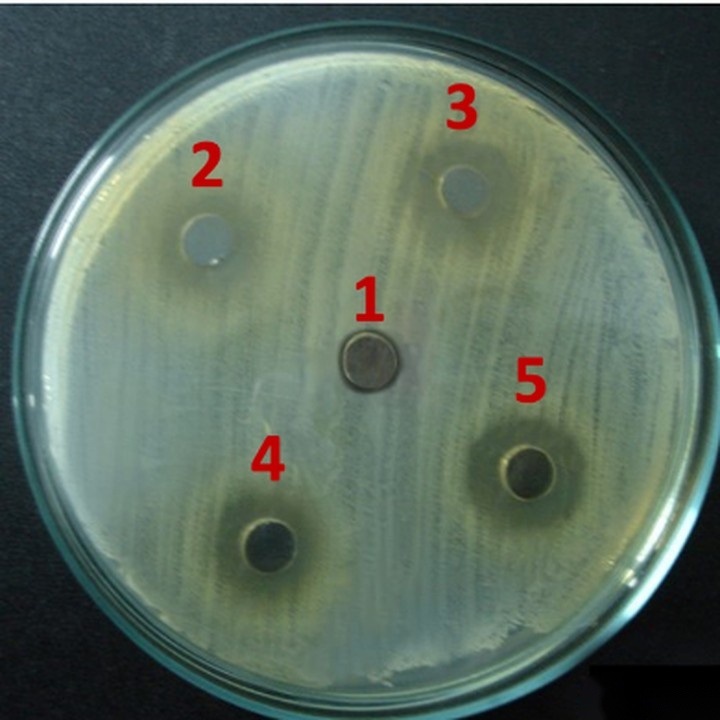
Plate A
MRSA · S. aureus
Methicillin-resistant Staphylococcus aureus. The chemical comparator discs show little measurable clearance, while the three-compound condition produces the widest zone.
1–2 Chemical antibiotics, 30 µg3 Single compound4 Two compounds5 Three compounds — 15 mm
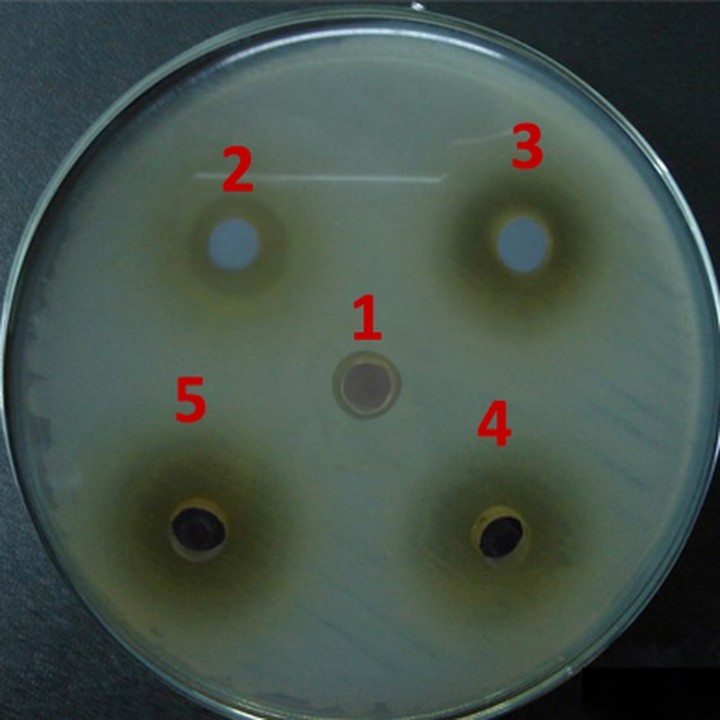
Plate B
MDR S. typhi
Multidrug-resistant Salmonella enterica serotype Typhi. The same five-condition sequence is shown, with the three-compound condition reaching the largest measured inhibition zone.
1–2 Chemical antibiotics, 30 µg3 Single compound4 Two compounds5 Three compounds — 20 mm
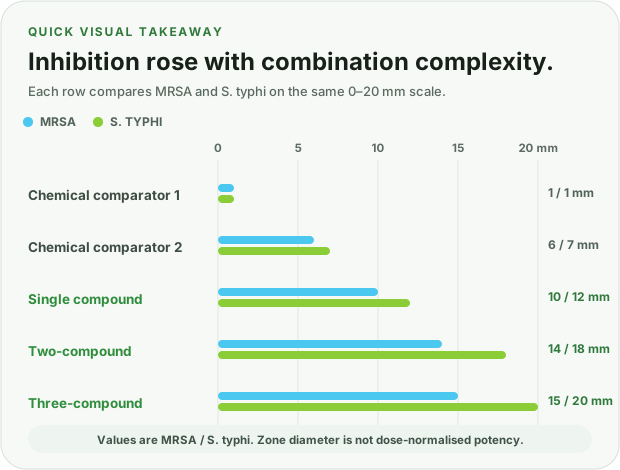
Measured results
Same five conditions. Two resistant clinical isolates.
Zone of inhibition (mm)
Within the same assay, larger zones indicate greater inhibition. Compound identities and exact formulation ratios remain confidential pending patent filing.
Method and result
What we tested and what the plates show.
Method. Forty-one candidate combinations were screened against clinical MRSA and multidrug-resistant S. typhi. The two chemical comparator conditions used 30 µg; the single, dual and triple plant-derived conditions used 600 µg per component.
Result. The two chemical comparators produced 1–7 mm zones. Activity increased from the single condition to the dual and triple cocktails, reaching 15 mm against MRSA and 20 mm against S. typhi.
Shared method. Disc diffusion and Agar Well Diffusion Method repeated assays. Numbered discs represent the same five test conditions on both plates. Compound identities and ratios are withheld pending patent filing; the photographs are our own and the labels were redrawn for clarity.
The horizontal scale starts at zero. Zone diameter is not dose-normalised potency and does not establish equivalence between the comparator and plant-derived conditions.
02 ·Interpretation
Credible proof of concept, not animal efficacy.
Repeated inhibition of two multidrug-resistant clinical isolates justifies the next validation stage.
The funded work must add MIC/MBC, time-kill, resistance development, mechanism, safety, stability, live-bird evidence, independent replication and peer review.
Next studies
What the funded phase produces
MIC/MBC and time-kill testing across more isolates
Resistance-development and mechanism assays
Initial cytotoxicity, formulation and stability
Controlled broiler study to EFSA data standards
Independent CRO verification
03 ·Target product profile
What we are building towards.
This is the specification a Green Antibiotics product must meet before market entry. Every line is a target with a study attached, not a result already held.
Target 01
Residue clearance
No accumulation in meat or eggs; assessed through residue analysis in the broiler study.
Target 02
No-withdrawal goal
Use through to slaughter; assessed through depletion data and regulatory classification.
Target 03
Dose tolerance
Normal health and performance at the intended dose; assessed in safety and tolerance arms.
Target 04
Lead stability
Seven characterised, shelf-stable cocktails; assessed through MIC panels and stability testing.
Development boundary
Every item above remains a target until residue, tolerance, stability and regulatory studies convert it into evidence.
Essential-oil compounds can be concentration-dependent and formulation-sensitive.17
04 ·Data access
Full data set available under NDA.
Raw plate images, measurement tables, repeat data and the screening protocol are available to investors, partners and scientific collaborators on request.
We publish the denominator, not only the seven leads. A screening claim without its denominator is a marketing claim. This is the standard the founders would apply to a pharmaceutical programme, and the fastest way to judge whether a signal is real.
Scientific references1 source used on this page
17
Alves-Silva J M, Zuzarte M, Girão H, Salgueiro L, et al.
Alves-Silva J M, Zuzarte M, Girão H, Salgueiro L, et al. Reviews on the antimicrobial efficacy, volatility, instability and concentration-dependent toxicity of essential-oil compounds in animal production, including microencapsulation as a mitigation strategy. Antibiotics, 14(6):552, 2025. mdpi.com/2079-6382/14/6/552