Pre-seed open · 12 months to first market
AVIX Pharmaceuticals Limited · United Kingdom & Bangladesh
Investors & partnerships
Funding twelve months of evidence, IP and first revenue.
We are early-stage with in-vitro proof of concept, no filed IP and no product on the market. This page says exactly what stage we are at and what the money buys.
01 ·The case
Why this, why now.
A billion-dollar phytogenic category is growing at about 6% a year, with antimicrobial replacement already a leading application13. Regulation is also reducing routine antibiotic use in key export markets10.
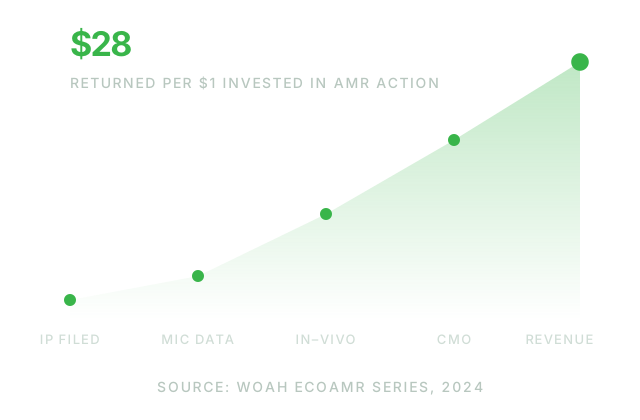
Livestock antibiotic use is still projected to rise almost 30% by 20402, while AMR action is modelled to return US$28 for every US$1 invested6.
Green Antibiotics combines reproducible in-vitro leads with a twelve-month plan to filed IP, live-bird evidence and first revenue.
Position, stated plainly
Where we are not yet
- No patent applications filed. Filing is the first use of funds.
- No in-vivo efficacy, toxicology or residue data.
- No product authorised for sale in any jurisdiction.
- No revenue and no commercial agreements in force.
- Regulatory classification not yet confirmed with advisers.
- Screening data not yet peer reviewed or independently replicated.
02 ·Use of fundsWhat the round pays for.
Indicative allocation. Final figures are in the investor pack.
OneIntellectual property
Prior-art work and priority patent filings before further disclosure.
TwoLaboratory programme
MIC/MBC, resistance, mechanism, safety and independent verification.
ThreeIn-vivo poultry study
One controlled broiler trial designed to EFSA data standards.
FourManufacture & QC
CMO batches, potency assay, stability and controlled sourcing.
FiveRegulatory strategy
Classification advice for Bangladesh, UK and EU pathways.
SixTeam
Add animal-health regulatory and commercial execution capability.
03 ·Risk factorsWhat could go wrong.
Every early-stage investment carries risk. These are the specific ones here.
RiskIn-vitro may not translate
Agar activity may not reproduce in a live bird; the broiler study is the first gate.
RiskNo IP filed yet
The combinations stay unprotected until priority patent applications are filed.
RiskClassification unconfirmed
Classification sets dossier scope, cost and timeline differently in each market.
RiskRaw material variability
Botanical potency must be controlled across harvests, suppliers and extraction batches.
RiskWell-capitalised rivals
Large incumbents hold the distribution; our differentiation has to be stronger evidence.
RiskA possible efficacy ceiling
Phytogenics may lose efficacy under heavy challenge; cocktails must close the gap.12
04 ·Risk mitigation
How each of those risks is being closed.
Listing risks is easy. What matters to an investor is whether the plan retires them in a defined order, at a defined cost, with people who have done it before. Every mitigation below maps to a funded, dated deliverable in the twelve-month plan.
Mitigating · in-vitro may not translate
De-risk biology first
Run the live-bird study early; published work already supports this compound class in poultry.18
Mitigating · no IP filed
File before major spend
File priority patent applications before any further disclosure, publication or partner discussion.
Mitigating · regulatory classification
Keep two regulatory tracks
Confirm classification early and run the fast regional route beside the EFSA dossier.
Mitigating · raw material variability
Standardise the raw materials
Control botanical variability through potency specifications and a formal stability programme.17
Mitigating · well-capitalised competition
Compete on stronger evidence
Compete on named-pathogen, resistant-isolate evidence that the large brands do not publish.
Mitigating · efficacy ceiling
Use the combination advantage
Multi-compound synergy is supported by published poultry work and our own screening.19
05 ·Capital efficiency
Why this round is small, and deliberately so.
The round buys four re-rating milestones: filed IP, MIC data, resistance testing and one controlled poultry study.
Bangladesh operations provide a lower-cost base in the highest-burden AMR region1, while the UK company holds IP and the international regulatory pathway.
- Each tranche funds one defined milestone.
- Track A targets revenue before the next raise.
- Studies are designed once to the higher standard.
- Partners carry distribution build-out costs.
- IP, assay expansion and poultry validation come first.
- Every work package has a clear stop-or-go gate.
Execution risk — the one investors ask about last
This team has already done this once
Avix has already moved T-Booster from laboratory concept through a completed 260-volunteer human study, manufacturing coordination and commercial preparation.
Dr David Brown adds senior discovery experience, Viagra co-invention, Relpax contribution and the published resistance-breaker concept5.
- One product already taken from concept to completed human study.
- Twenty-four staff across eleven disciplines already in post.
- UK company holds the IP; Bangladesh operations hold the cost base.
Scientific references10 sources used on this page
13Grand View Research.
Grand View Research. Phytogenic Feed Additives Market Size, Share & Trends Analysis Report by Animal, Application, Distribution Channel and Region, Segment Forecasts 2025–2030. Market estimated at USD 1,047.9m (2024), forecast USD 1,484.7m (2030), 6.04% CAGR; poultry segment USD 492.6m (2024). grandviewresearch.com
European Union.
European Union. Regulation (EU) 2019/6 on veterinary medicinal products, and Regulation (EC) 1831/2003 on additives for use in animal nutrition, under which EFSA evaluates feed additives prior to authorisation. eur-lex.europa.eu
Acosta A, Tirado M V, Cheng L, et al.
Acosta A, Tirado M V, Cheng L, et al. The future of antibiotic use in livestock. Nature Communications, 16, 2025. doi:10.1038/s41467-025-56825-7
World Organisation for Animal Health (WOAH) and partners.
World Organisation for Animal Health (WOAH) and partners. EcoAMR series: Health and Economic Impacts of Antimicrobial Resistance in Humans and Food-Producing Animals, 2024. woah.org
Cardinal K M, Kipper M, Andretta I, Ribeiro A M L.
Cardinal K M, Kipper M, Andretta I, Ribeiro A M L. Can phytogenic additives improve the performance of broilers and replace growth-promoting antibiotics? A meta-analytic approach. Canadian Journal of Animal Science, 2022. doi:10.1139/cjas-2021-0058
Shaji S, Selvaraj R K, Shanmugasundaram R, et al.
Shaji S, Selvaraj R K, Shanmugasundaram R, et al. Exploring the effects of phenolic compounds and essential oils in poultry: a sustainable strategy to combat Salmonella biofilm infections. Poultry Science, 2025. Reviews broad-spectrum activity, multi-target mechanism, and in-vivo reductions of Salmonella and Campylobacter of up to 50% in two weeks. doi:10.1016/j.psj.2025.105982
Alves-Silva J M, Zuzarte M, Girão H, Salgueiro L, et al.
Alves-Silva J M, Zuzarte M, Girão H, Salgueiro L, et al. Reviews on the antimicrobial efficacy, volatility, instability and concentration-dependent toxicity of essential-oil compounds in animal production, including microencapsulation as a mitigation strategy. Antibiotics, 14(6):552, 2025. mdpi.com/2079-6382/14/6/552
Peñalver-Soler R, et al.
Peñalver-Soler R, et al. Antimicrobial activity of Origanum vulgare L. and Salvia rosmarinus essential oil combinations against Escherichia coli and Salmonella Typhimurium isolated from poultry. Processes, 13(9):2856, 2025. Checkerboard synergy across five pH levels; strongest synergy at pH ≤ 5.5. doi:10.3390/pr13092856
GBD 2021 Antimicrobial Resistance Collaborators.
GBD 2021 Antimicrobial Resistance Collaborators. Global burden of bacterial antimicrobial resistance 1990–2021: a systematic analysis with forecasts to 2050. The Lancet, 404(10459):1199–1226, 2024. doi:10.1016/S0140-6736(24)01867-1
Brown D.
Brown D. Antibiotic resistance breakers: can repurposed drugs fill the antibiotic discovery void? Nature Reviews Drug Discovery, 14:821–832, 2015. doi:10.1038/nrd4675 — authored by Green Antibiotics co-developer Dr David Brown.