Pre-seed open · 12 months to first market AVIX Pharmaceuticals Limited · United Kingdom & Bangladesh
The science

Smart combinations.
Multiple targets.
One clear strategy.

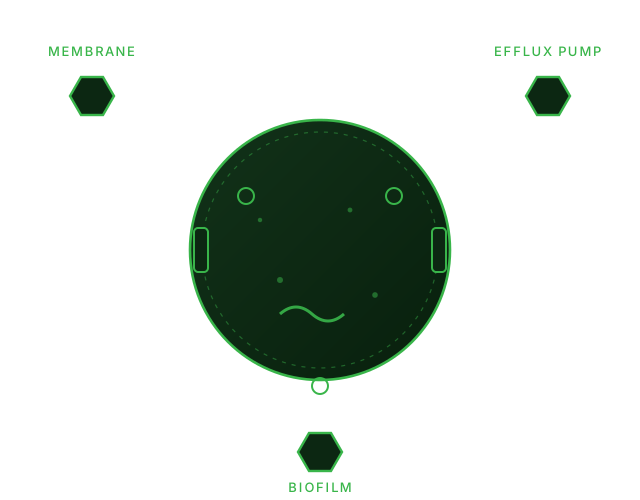
A conventional antibiotic usually acts on one molecular target, and a single mutation can defeat it. We design defined cocktails intended to act on several bacterial targets at once — the same logic that underpins combination therapy in tuberculosis and HIV.

Three compounds acting on membrane, efflux pump and biofilm targets of a bacterial cell
01 ·The platform

How a candidate is built.

A repeatable four-stage process, run to drug-discovery standards rather than feed-industry standards.

Step one

Compoundselection

Choose feed-compatible plant antimicrobials with published activity and a scalable, traceable supply.

Step two

Combinationdesign

Fix defined ratios so each cocktail engages membrane, efflux and biofilm targets together.

Step three

Repeatscreening

Test every cocktail against resistant clinical isolates alongside a conventional antibiotic comparator.

Step four

Selectionor rejection

Advance only reproducible leads.Seven combinations moved forward.Thirty-four were rejectedand stopped from development.

02 ·Mechanism

Three ways a plant phenolic can disable a resistant cell.

Carvacrol, thymol and related phenolics are well studied and can act on several bacterial vulnerabilities.

Target one

Membrane disruption

Carvacrol and thymol can disruptbacterial membranes and increasepermeability8.

Target two

Efflux pump inhibition

Thymol and carvacrol can inhibit efflux,reducing tetracycline MIC two- toeight-fold in combination9.

Target three

Biofilm prevention

Both compounds can limit biofilm formationand reduce established biofilms, withadditive or synergistic effects8.

The resistance breaker

A second route: restore the antibiotics we already have.

Dr David Brown proposed restoring failing antibiotics with non-antibiotic resistance breakers in Nature Reviews Drug Discovery5.

Our funded programme tests both replacement activity and whether the cocktails can reduce the effective dose of conventional drugs.

Why this matters here

Mechanism and compound class meet at one protein

Azithromycin resistance in S. Typhi can arise from an AcrB efflux-pump mutation7. The same pump class is reported to be inhibited by carvacrol and thymol9.

This is the rationale for funded mechanistic testing of our specific cocktails; it is not yet a demonstrated mechanism in our isolates.

03 ·Target pathogens

Chosen because they are hard, and because they matter to both animals and people.

Target one · WHO high priority

Methicillin-resistant Staphylococcus aureus

MRSA is a WHO high-priority pathogen4. Its attributable deaths more than doubled from 1990 to 20211, and it can move through poultry handling and food.

Target two · WHO high priority

Salmonella, including S. Typhi

Fluoroquinolone-resistant S. Typhi is the highest-ranked community-acquired pathogen on the WHO 2024 list. WHO links much non-typhoidal Salmonella resistance to antibiotic use in animal husbandry4.

Evidence boundary

Resistance still requires direct testing.

Serial-passage studies must show whether repeated exposure slows or accelerates resistance. Plant-derived chemistry is not automatically safe; dose, toxicity, residues and performance require formal testing.12

IP boundary

Formulations remain confidential until filing

Public literature supports the compound classes and mechanisms, not our exact ratios. Detailed composition and screening data are shared under NDA until priority patent applications are filed.

Scientific references7 sources used on this page
08

Nostro A, Marino A, Ginestra G, et al.

Nostro A, Marino A, Ginestra G, et al. Carvacrol and thymol: a synergistic antimicrobial activity against bacterial and Candida species. Reviewed evidence on membrane damage, efflux-pump inhibition and biofilm prevention, 2025. PMC12541891

09

Miladi H, Zmantar T, Chaabouni Y, et al.

Miladi H, Zmantar T, Chaabouni Y, et al. Antibacterial and efflux pump inhibitors of thymol and carvacrol against food-borne pathogens. Microbial Pathogenesis, 99:95–100, 2016. doi:10.1016/j.micpath.2016.08.008

05

Brown D.

Brown D. Antibiotic resistance breakers: can repurposed drugs fill the antibiotic discovery void? Nature Reviews Drug Discovery, 14:821–832, 2015. doi:10.1038/nrd4675 — authored by Green Antibiotics co-developer Dr David Brown.

07

Sajib M S I, Tanmoy A M, Hooda Y, et al.

Sajib M S I, Tanmoy A M, Hooda Y, et al. Tracking the emergence of azithromycin resistance in multiple genotypes of typhoidal Salmonella. mBio, 12(1), 2021. Identifies the AcrB R717Q/L efflux-pump mutation, first reported in Bangladesh. doi:10.1128/mBio.03481-20

04

World Health Organization.

World Health Organization. WHO Bacterial Priority Pathogens List 2024: a prioritisation study to guide research, development and public health strategies against antimicrobial resistance. The Lancet Infectious Diseases, 2025. doi:10.1016/S1473-3099(25)00118-5

01

GBD 2021 Antimicrobial Resistance Collaborators.

GBD 2021 Antimicrobial Resistance Collaborators. Global burden of bacterial antimicrobial resistance 1990–2021: a systematic analysis with forecasts to 2050. The Lancet, 404(10459):1199–1226, 2024. doi:10.1016/S0140-6736(24)01867-1

12

Cardinal K M, Kipper M, Andretta I, Ribeiro A M L.

Cardinal K M, Kipper M, Andretta I, Ribeiro A M L. Can phytogenic additives improve the performance of broilers and replace growth-promoting antibiotics? A meta-analytic approach. Canadian Journal of Animal Science, 2022. doi:10.1139/cjas-2021-0058

From rationale to result

A scientific idea only matters when the evidence can be measured.

Review what the screening programme has shown and where the limits still are.