
The crisis
Resistance is selected on farms and paid for in hospitals.
Antimicrobial resistance is not a forecast risk. It is a measured, rising burden that has already killed more than a million people a year, every year, since 19901. Animal agriculture is one of its largest single drivers — and the sector's own economics now depend on solving it.
01 ·Scale
39mAttributable deaths, 2025–2050
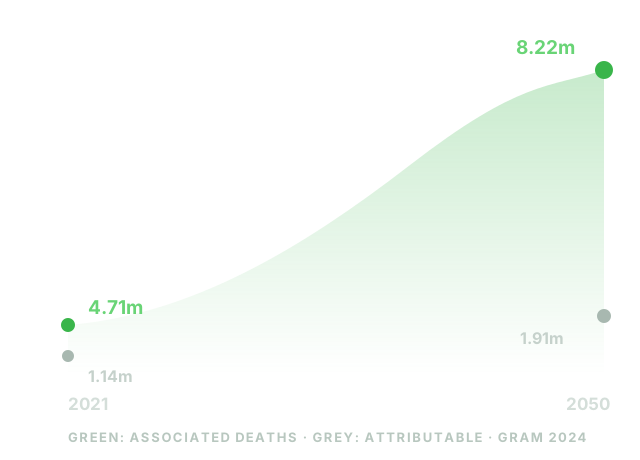
8.22mAssociated deaths in 2050
1.91mAttributable deaths in 2050
11.8mSouth Asia deaths, 2025–2050
130kMRSA deaths recorded in 2021
92mDeaths potentially averted
One million deaths a year, every year, since 1990.
The 2024 GRAM analysis used more than 520 million records across 204 countries and projects a steep rise in bacterial AMR to mid-century1.
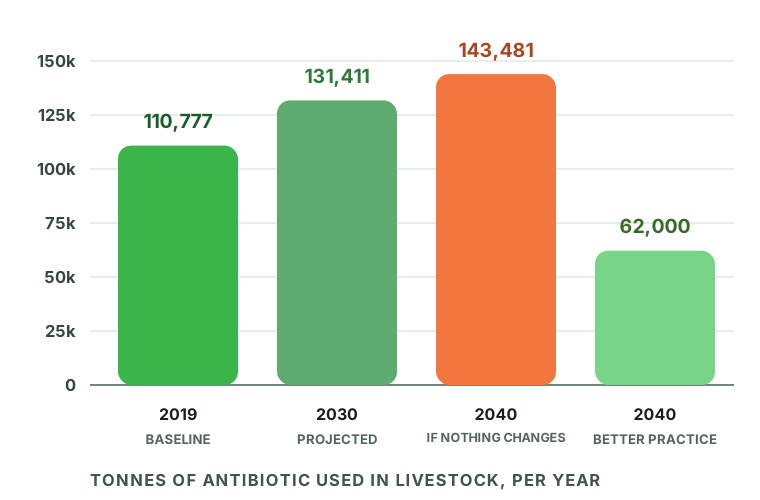
Projected livestock antibiotic use, tonnes
← Swipe chart to see full scale
FAO-led projection published in Nature Communications, 20252. The optimised-productivity scenario shows that the trajectory is a choice, not a given. Asia and the Pacific are projected to account for close to two thirds of global livestock antimicrobial use by 2040.
02 ·Agriculture's role
Where the antibiotics actually go.
Most veterinary antimicrobials are not used to treat an identified sick animal. They are administered across flocks and ponds in feed and water — and in some countries, still to make animals grow faster.
Growth promotion
Still in routine use
- ~20% report growth-promoter use.
- 11% still report colistin for growth.
- Colistin is critically important to human medicine.
Concentration
A few markets dominate
- China used ~32,776 tonnes in 2020.
- Use is concentrated in a few major markets.
- Asia represents ~67% of the global total3.
Regulation
Tightening steadily
- EU growth-promoter ban: 2006.
- EU 2019/6 further limits routine prophylaxis10.
- Exporters need credible alternatives.
03 ·One Health
Resistance moves in a cycle across animals, people and the environment.
Antibiotic use in one domain can select resistant bacteria that reach the others through food, direct contact, waste, water, soil and feed.
- Animals to people: meat, eggs, fish and direct handling can carry resistant organisms.
- People and animals to the environment: manure, sewage and effluent can disperse bacteria and residues.
- Environment back to farms and communities: water, crops, soil and feed reconnect the cycle.
- WHO, FAO, UNEP and WOAH therefore frame AMR as a coordinated One Health problem.21
- Reducing the need for antimicrobials in agriculture is part of the global 2026–2036 action agenda.22
Breaking the cycle
Intervene at more than one interface
Reducing avoidable antimicrobial exposure, strengthening waste controls
and validating effective alternatives can lower selection pressure across the cycle.21

The regional edge case
Typhoid is running out of drugs
Extensively drug-resistant Salmonella Typhi emerged in Pakistan with plasmid-borne resistance to fluoroquinolones and third-generation cephalosporins15, leaving azithromycin as the only broadly effective oral treatment across South Asia. Azithromycin resistance was then reported, first in Bangladesh, through a single-point mutation in the AcrB efflux pump7. This is the organism and region where our lead candidate shows its strongest in-vitro activity.
04 ·The economics
Acting is roughly six times cheaper than not acting.
The EcoAMR modelling combines human and food-producing-animal impacts across 204 countries, showing that antimicrobial resistance is simultaneously a health, food-security and economic risk.
FAO's assessment reaches the same practical conclusion: over the long term, the cost of inaction is roughly six times the cost of action.11 Alternatives that reduce reliance on antibiotics in animal production are therefore an economic requirement as well as a One Health priority.
US$1.7tn
Potential annual global GDP loss by 2050 under unchecked resistance.6
US$5.2tn
Potential cost of resistant pathogens spreading from livestock to humans.6
2bn
People whose food supply could be jeopardised by AMR-driven livestock losses.6
US$28
Modelled return for every US$1 invested in action now.6
Scientific references10 sources used on this page
GBD 2021 Antimicrobial Resistance Collaborators.
GBD 2021 Antimicrobial Resistance Collaborators. Global burden of bacterial antimicrobial resistance 1990–2021: a systematic analysis with forecasts to 2050. The Lancet, 404(10459):1199–1226, 2024. doi:10.1016/S0140-6736(24)01867-1
Acosta A, Tirado M V, Cheng L, et al.
Acosta A, Tirado M V, Cheng L, et al. The future of antibiotic use in livestock. Nature Communications, 16, 2025. doi:10.1038/s41467-025-56825-7
Mulchandani R, Wang Y, Gilbert M, Van Boeckel T P.
Mulchandani R, Wang Y, Gilbert M, Van Boeckel T P. Global trends in antimicrobial use in food-producing animals: 2020 to 2030. PLOS Global Public Health, 3(2):e0001305, 2023. doi:10.1371/journal.pgph.0001305
European Union.
European Union. Regulation (EU) 2019/6 on veterinary medicinal products, and Regulation (EC) 1831/2003 on additives for use in animal nutrition, under which EFSA evaluates feed additives prior to authorisation. eur-lex.europa.eu
WHO, FAO, UNEP and WOAH.
WHO, FAO, UNEP and WOAH. Quadripartite guidance on One Health integrated surveillance of antimicrobial resistance and use, 2025. openknowledge.fao.org
World Organisation for Animal Health.
World Organisation for Animal Health. Updated Global Action Plan on Antimicrobial Resistance 2026–2036: One Health surveillance, prevention, appropriate use, research, governance and accountability. woah.org
Klemm E J, Shakoor S, Page A J, et al.
Klemm E J, Shakoor S, Page A J, et al. Emergence of an extensively drug-resistant Salmonella enterica serovar Typhi clone harbouring a promiscuous plasmid encoding resistance to fluoroquinolones and third-generation cephalosporins. mBio, 9(1), 2018. doi:10.1128/mBio.00105-18
Sajib M S I, Tanmoy A M, Hooda Y, et al.
Sajib M S I, Tanmoy A M, Hooda Y, et al. Tracking the emergence of azithromycin resistance in multiple genotypes of typhoidal Salmonella. mBio, 12(1), 2021. Identifies the AcrB R717Q/L efflux-pump mutation, first reported in Bangladesh. doi:10.1128/mBio.03481-20
Food and Agriculture Organization of the United Nations.
Food and Agriculture Organization of the United Nations. The Future of Antimicrobial Use in Livestock: The Economic Cost of Action or Inaction, 2026. openknowledge.fao.org
World Organisation for Animal Health (WOAH) and partners.
World Organisation for Animal Health (WOAH) and partners. EcoAMR series: Health and Economic Impacts of Antimicrobial Resistance in Humans and Food-Producing Animals, 2024. woah.org