Pre-seed open · 12 months to first market AVIX Pharmaceuticals Limited · United Kingdom & Bangladesh
Pipeline & market

Seven leads.
A real market.
A measured plan.

Seven confirmed leads, a category already worth more than a billion dollars, and a deliberately conservative view of the ground we can take first. Here is the pipeline, the market behind it, and the incumbents we intend to out-evidence.

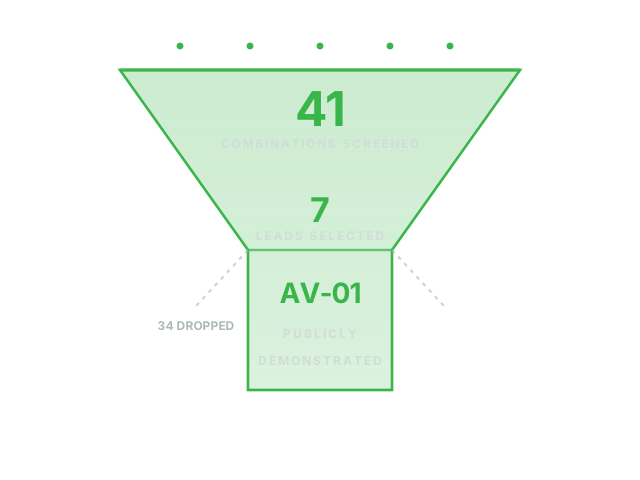
Funnel narrowing from 41 screened combinations to 7 leads to one demonstrated lead
01 ·Reading the range

Why credible estimates differ by more than double.

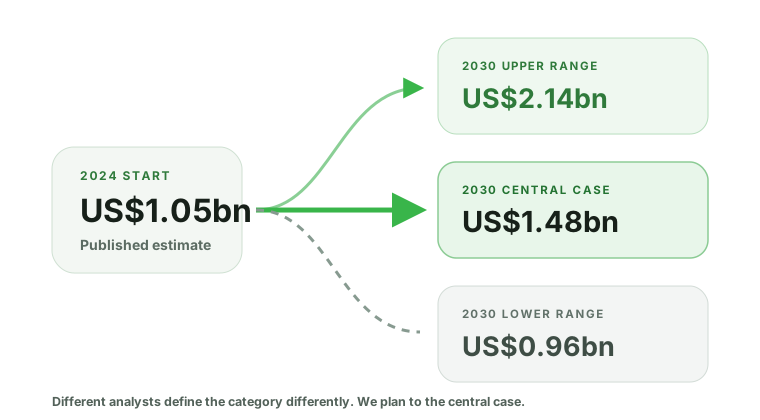
Analysts define phytogenic additives differently. We plan against the conservative estimate while recognising that broader definitions produce a market more than twice as large.

  • Poultry leads: about US$493m in 202413.
  • Asia Pacific leads and sits closest to our supply base.
  • Antimicrobial replacement is already a leading use case13.
  • Regional essential-oil supply supports competitive inputs.
  • Central case = plan; upper case = upside, not forecast.
  • Market definitions stay separate; we do not blend estimates.
Phytogenic feed additive market, USD
Phytogenic feed additive market growing from 1.05 billion dollars in 2024 to a central case of 1.48 billion by 2030 within an analyst range of 0.96 to 2.14 billion

← Swipe chart to see full scale

Central case: Grand View Research, US$1.05bn in 2024 to US$1.48bn in 2030, 6.04% CAGR13. Upper: Strategic Market Research, US$2.14bn by 2030. Lower: Mordor Intelligence, US$955m on a narrower category definition.

02 ·Pipeline

Seven lead cocktails: AV-01 to AV-07.

Seven defined three-compound cocktails progressed from 41 screened combinations. Every lead has reproducible in-vitro activity; none is presented as animal-validated or market-ready.

Publicly demonstrated lead
AV-01
Proprietary three-compound cocktail (A + B + C)
The triple-compound cocktail presented in our public evidence. In repeat disc-diffusion assays it produced clear zones against both test organisms — approximately 20 mm against multidrug-resistant Salmonella Typhi and 15 mm against MRSA — where the comparator antibiotic produced little or none.
TargetsMRSA & MDR S. Typhi
ApplicationBroiler poultry — in-feed or in-water
StageIn-vitro lead confirmed
NextMIC/MBC characterisation, then controlled in-vivo poultry study
AV-02
Three-compound cocktail
Second lead, focused on enteric Salmonella control in poultry.
TargetSalmonella spp.
DeliveryBroiler & layer, in-water
StageIn-vitro lead confirmed
AV-03
Three-compound cocktail
Directed at colibacillosis-associated E. coli, a leading cause of poultry morbidity and carcass condemnation.
TargetEscherichia coli
DeliveryBroiler, in-feed
StageIn-vitro lead confirmed
AV-04
Three-compound cocktail
Targeting Campylobacter, the leading cause of bacterial foodborne illness in many high-income markets.
TargetCampylobacter spp.
DeliveryBroiler, in-water
StageIn-vitro lead confirmed
AV-05
Three-compound cocktail
Companion lead to AV-01 against staphylococcal infection, developed for feed-based delivery.
TargetS. aureus incl. MRSA
DeliveryBroiler & layer, in-feed
StageIn-vitro lead confirmed
AV-06
Three-compound cocktail
Addressing Klebsiella, an opportunistic and increasingly carbapenem-resistant organism.
TargetKlebsiella spp.
DeliveryPoultry, in-water
StageIn-vitro lead confirmed
AV-07
Three-compound cocktail
Broad-spectrum lead intended to cover mixed enteric pathogens common in intensive systems.
TargetBroad enteric panel
DeliveryLayer & broiler
StageIn-vitro lead confirmed

Composition remains confidential pending IP filing. All seven leads are confirmed within the in-vitro screening programme; efficacy, safety, residues and withdrawal characteristics in live animals remain to be established.

03 ·The blockbuster thesis

One supplement. Every major poultry pathogen.

The commercial goal is one practical supplement covering the major bacterial pressures in poultry through multi-target, plant-derived chemistry.

Plant phenolics can disrupt membranes, ion transport, efflux, energy production and biofilms, supporting activity across several pathogen classes.18

Published poultry evidence reports reductions in Salmonella and Campylobacter, while combination studies show stronger synergy under acidic gut-like conditions.1819

  • One formulation architecture, tested against a defined pathogen panel.
  • Multiple mechanisms reduce dependence on a single molecular target.
  • The funded programme tests breadth, dose and live-bird translation directly.
Coverage

Salmonella

Food-safety and export risk carried through gut, eggs, meat and litter.

Coverage

E. coli

Major cause of colibacillosis, mortality and carcass condemnation.

Coverage

C. perfringens

Drives necrotic enteritis and performance loss as antibiotic use falls.

Coverage

Campylobacter

Leading foodborne pathogen and retailer-led control target.

Coverage

Klebsiella

Opportunistic pathogen with growing multidrug-resistance concern.

Product goal

Broad-spectrum

A single practical supplement tested across mixed enteric pressures.

The honest boundary

All seven cocktails are in-vitro confirmed; full-panel coverage remains the next test.

The broad “all major poultry pathogens” product goal still requires expanded testing against E. coli, C. perfringens, Campylobacter and live-bird validation. We distinguish confirmed in-vitro leads from future product claims.

04 ·Competitive position

Who we are competing with.

The category has substantial incumbents with distribution we do not have. Our route in is evidence they have not generated, in a segment they under-serve.

Player typeExamplesStrengthWhere we differentiate
Global nutrition majorsCargill · DSM-Firmenich · Adisseo · IFF · Land O'LakesScale · regulation · distributionLimited focus on named resistant pathogens
Phytogenic specialistsDelacon · Phytobiotics · Kemin · AnparioEstablished phytogenic productsLimited controlled named-isolate data
Regional producersSouth Asian manufacturersPrice · proximity · relationshipsVariable characterisation and regulatory depth
Green AntibioticsAVIX Pharmaceuticals7 leads from 41 screenedDefined platform advancing to validation
Cost in use

Parity is the target

Cost parity with in-feed antimicrobials, using regional raw materials.

Performance

It pays for itself

One broiler cycle shows the effect on mortality, weight and feed conversion.

Market access

It keeps the buyer

Export producers need compliant alternatives as UK and EU rules tighten.

Scientific references3 sources used on this page
13

Grand View Research.

Grand View Research. Phytogenic Feed Additives Market Size, Share & Trends Analysis Report by Animal, Application, Distribution Channel and Region, Segment Forecasts 2025–2030. Market estimated at USD 1,047.9m (2024), forecast USD 1,484.7m (2030), 6.04% CAGR; poultry segment USD 492.6m (2024). grandviewresearch.com

18

Shaji S, Selvaraj R K, Shanmugasundaram R, et al.

Shaji S, Selvaraj R K, Shanmugasundaram R, et al. Exploring the effects of phenolic compounds and essential oils in poultry: a sustainable strategy to combat Salmonella biofilm infections. Poultry Science, 2025. Reviews broad-spectrum activity, multi-target mechanism, and in-vivo reductions of Salmonella and Campylobacter of up to 50% in two weeks. doi:10.1016/j.psj.2025.105982

19

Peñalver-Soler R, et al.

Peñalver-Soler R, et al. Antimicrobial activity of Origanum vulgare L. and Salvia rosmarinus essential oil combinations against Escherichia coli and Salmonella Typhimurium isolated from poultry. Processes, 13(9):2856, 2025. Checkerboard synergy across five pH levels; strongest synergy at pH ≤ 5.5. doi:10.3390/pr13092856

From leads to milestones

A defined lead set needs a disciplined sequence of technical and regulatory gates.

See what the next twelve months are designed to deliver.